YOUR LIFT
Calculate your one-rep max
Enter the weight you lifted and the number of clean reps you completed.
An estimate for training, not a tested maximum.
Training weights
| Intensity | Target weight | What it means |
|---|
Percentage weights are based on the Epley estimate and are rounded to one decimal. They aren't personalized prescriptions.
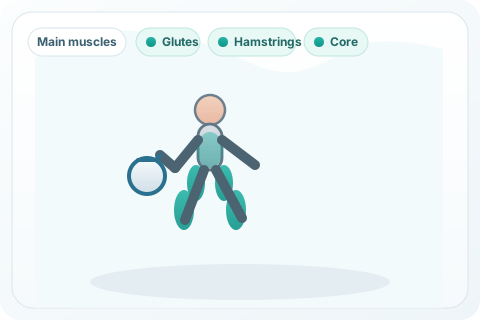
Primary muscles are highlighted in teal.
PRIMARY MUSCLES
How to perform the kettlebell swing
- Hinge back with the kettlebell between your legs and keep your spine neutral.
- Drive your hips forward to swing the bell rather than lifting it with your arms.
- Let the bell return naturally and hinge again for the next rep.
Muscles worked
Main focus: Glutes and hamstrings
Also involved: Trunk and grip
Form tip
Hinge at the hips and drive the bell with your legs, not your arms.
Common mistake
Turning the swing into a squat or a front raise.
Safety and setup
Practise the hip hinge with a lighter bell first.
Hinge at your hips and use a bell you can control.
For this movement, repetitions, technique, distance or assisted/added load may be more useful than a predicted one-rep max.
This calculator uses the total external load you enter. For dumbbell exercises, use the weight per dumbbell and be consistent when comparing workouts. For machine exercises, keep the same machine and setup, because stacks and leverage differ.
Related exercises
UNDERSTAND YOUR RESULT
What is a one-rep max?
Your one-repetition maximum (1RM) is the greatest weight you can lift once with proper form for a particular exercise. You can estimate it without attempting a heavy single: enter the weight and reps from a challenging set.
Our default estimate uses the Epley formula. We also show the Brzycki estimate so you can see that there isn't one exact formula for every lifter. The estimates become less dependable as repetitions rise, especially if the set wasn't close to your actual limit.
How accurate is a 1RM calculator?
It's a useful starting point for planning, not a guarantee of what you can lift. Rep technique, training experience, fatigue, equipment, and proximity to failure all matter. Use a recent, consistent set, ideally around 3–6 hard repetitions, and never treat the result as a reason to attempt an unsafe maximum.